Everything you need to plan a trek in the Khumbu — which route suits your days, when the skies are clearest, and how the Lukla flight, permits and acclimatisation fit together.
Why trek in the Everest Region
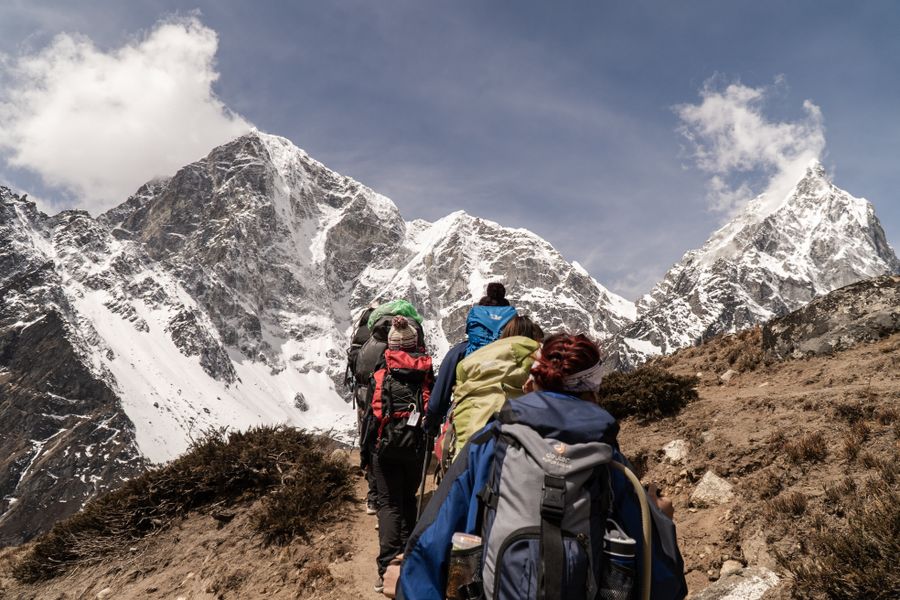
No other trekking region puts you this close to so many of the world's highest peaks. Everest, Lhotse, Makalu and Cho Oyu all stand within a few days' walk of Namche Bazaar, and Ama Dablam watches over most of the trail.
It is also Sherpa country. Monasteries at Tengboche and Pangboche, prayer-flag bridges over the Dudh Koshi and stone-walled potato fields give the walk a culture as strong as the scenery.
Popular treks
- Everest Base Camp — the classic 12–14 day return walk to base camp and the sunrise viewpoint of Kala Patthar.
- Gokyo Lakes — turquoise glacial lakes and the view from Gokyo Ri, often quieter than the base camp trail.
- Three Passes — Kongma La, Cho La and Renjo La in one loop — for fit walkers with some altitude experience.
- Pikey Peak — a shorter, lower route in the Solu hills with a wide panorama that includes Everest.
When to go
| Season |
Months |
What to expect |
| Spring |
Mar–May |
Rhododendrons in bloom lower down, warmer days, expedition season at base camp. |
| Monsoon |
Jun–Aug |
Cloud and rain, frequent flight delays at Lukla. Only for flexible schedules. |
| Autumn |
Sep–Nov |
Clearest skies and the busiest trails. Book flights and lodges early. |
| Winter |
Dec–Feb |
Cold nights above Dingboche but crisp views and far fewer people. |
Build at least one spare day into any Everest itinerary. Mountain weather grounds Lukla flights in every season, and a buffer day keeps a delay from costing you your international flight.
Permits and guides
You need a Sagarmatha National Park entry permit and the Khumbu Pasang Lhamu Rural Municipality permit. We arrange both before you fly, so there is nothing to queue for on the trail.
Trekking with a licensed guide is required in Nepal's national parks. Our guides know the lodge owners, the acclimatisation spots and the evacuation options — which matters more here than on any lower trek.
Getting there
Most treks start with the short flight to Lukla (2,860 m). In the busy seasons flights often leave from Ramechhap, a few hours' drive from Kathmandu, rather than Kathmandu itself. We handle the transfer and the early start.
If you would rather avoid the flight, the old approach walks in from Jiri or Phaplu through the Solu hills. It adds several days but gives a gentler start to acclimatisation.
On the trail
Teahouses run the whole way to Gorak Shep, with hot showers and Wi-Fi available for a charge in most villages. Rooms become simpler and colder the higher you go, so a warm sleeping bag is worth bringing.
Altitude is the real challenge. Itineraries include rest days at Namche and Dingboche, and our guides carry a pulse oximeter and turn groups around early at the first sign of trouble.
Walk slower than you think you need to on the first days out of Lukla. The people who reach Kala Patthar comfortably are the ones who took the climb to Namche easy.
Pokhara Treks guiding team