Itinerary at a glance
| Day |
Route |
Highest point |
Walking |
Overnight |
| 1 |
Kathmandu to Syabrubesi by bus |
about 2,030 m |
None |
Syabrubesi |
| 2 |
Syabrubesi to Ghoda Tabela |
about 3,040 m |
8 to 9 hours |
Ghoda Tabela |
| 3 |
Ghoda Tabela to Kyanjin Gompa |
3,870 m |
6 to 7 hours |
Kyanjin Gompa |
| 4 |
Kyanjin Ri, then down to Lama Hotel |
4,600 to 4,773 m |
9 to 11 hours |
Lama Hotel |
| 5 |
Lama Hotel to Syabrubesi, drive to Kathmandu |
about 2,480 m |
About 4 hours |
End of trek |
The route after the August 2026 flood
The upper Langtang valley was not in the path of the 26 August 2026 flood, which came down the Bhote Koshi, a different river. The Langtang Khola only joins it at Syabrubesi. What the flood destroyed was the way in: Syabrubesi itself, where more than 400 houses were swept away and many lives were lost, and long stretches of the road and bridges below it. The Trekking Agencies' Association of Nepal said in late October that Langtang and Kyanjin were open again, using alternative routes.
| Stretch |
Position in late October 2026 |
| Kathmandu, Betrawati, Dhunche |
Road open, with temporary bridges |
| Dhunche to Syabrubesi and the old trailhead |
Reports differ. One operator on the ground reported it still closed on 28 October, and it says to start elsewhere |
| Thulo Syabru |
The current starting point, reached by private jeep |
| Thulo Syabru, Bamboo, Lama Hotel |
Open. Locals repaired landslide sections near Rimche in October |
| Lama Hotel to Kyanjin Gompa |
Trail not damaged by the flood |
| Above 3,000 m, from 28 October |
Checkpoints turned trekkers back for a cyclone snow forecast. Confirm this has lifted |
How we run the trek while Syabrubesi is closed. The walk starts and ends at Thulo Syabru, about 2,220 m, instead of Syabrubesi. Regular buses do not go there, so you travel by private jeep.
| Day |
Current route |
| 1 |
Private jeep, Kathmandu to Thulo Syabru, 7 to 9 hours |
| 2 |
Thulo Syabru, Pairo, Bamboo, Lama Hotel to Ghoda Tabela |
| 5 |
Lama Hotel to Thulo Syabru, then jeep to Kathmandu |
We check the road and the trail before you leave and tell you what has changed. In this area people are rebuilding after a disaster, so please ask before taking photographs.
Altitude: why this itinerary is fast
The US Centers for Disease Control and Prevention (CDC) advises that above 3,000 m you should not raise your sleeping altitude by more than about 500 m a night. On this itinerary, you sleep about 1,580 m higher on night 2 and about 830 m higher on night 3, then go higher still on Kyanjin Ri the next morning. That is much faster than the advice, so altitude sickness is a real risk here.
We recommend adding days if you can. The most useful changes are a night at Lama Hotel on the way up, and a second night at Kyanjin Gompa. A 7-day version adds two days and USD X per person. It also turns day 4 from an exhausting rush into a real rest and a summit day.
What to watch for. Headache with nausea, loss of appetite, dizziness or unusual tiredness are the early signs of acute mountain sickness. Tell your guide at once. Confusion, stumbling, or breathlessness at rest are signs of serious altitude illness, and the only answer is to go down that hour. The good news here is that going down is easy, because the valley trail drops steadily.
Before you go. Ask your doctor whether acetazolamide (Diamox) makes sense for you. If you have had altitude sickness before, please choose a longer itinerary.
Langtang Valley trek difficulty: what makes it hard
The standard Langtang trek is rated moderate. This 5-day version is harder because it squeezes the same distance into fewer days.
Long days. Day 2 and day 4 are long by any standard, and you start at first light.
Big descents. Day 4 and day 5 together drop more than 3,000 m from the top of Kyanjin Ri. Poles and strong knees help.
Height. You sleep at 3,870 m after only two nights on the trail.
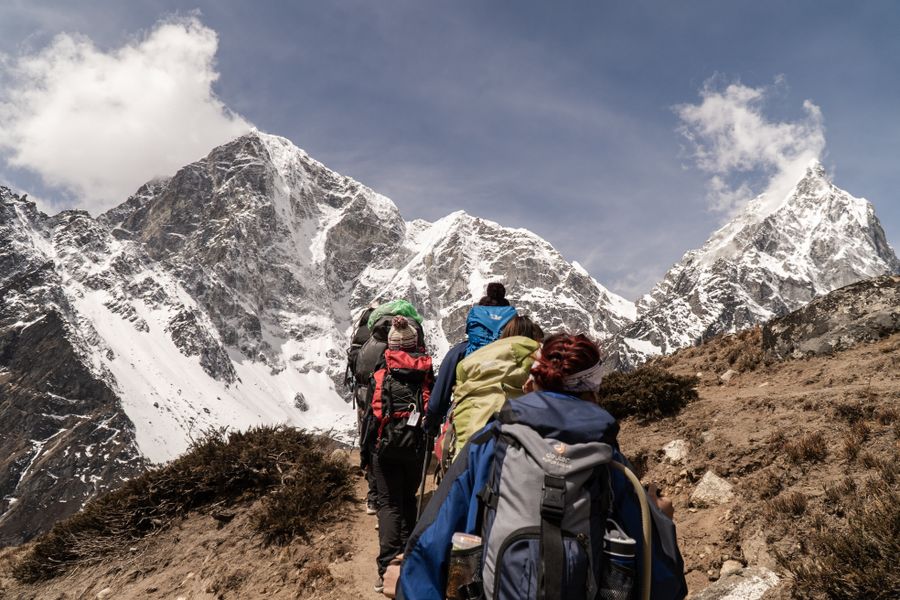
The Langtang trail itself is not technical: a clear path through forest and pasture, with stone steps and suspension bridges. Kyanjin Ri is a steep walk on rock and grass, with no climbing skills needed, but snow can make the upper part hard in spring and late autumn.
Langtang village: the 2015 avalanche and the rebuilt village
At 11:56 am on 25 April 2015, the Gorkha earthquake broke away a huge mass of ice and rock from the slopes of Langtang Lirung. The avalanche and its air blast buried almost all of Langtang village. Officially 306 people died: at least 175 of the local people in the valley, 82 Nepalis from elsewhere and 49 foreign tourists. Local people say the true number is higher.
The survivors came back and rebuilt the village themselves, on a site further up the valley. As you walk through, you pass the great field of rubble that buried the old village, and a memorial of stones carved with Buddhist mantras. Today most families here run teahouses, and staying with them directly supports the valley's recovery. People here regard this as a beyul, a hidden sacred land, and Langtang Lirung as its protector. Please take your time here, and be thoughtful in what you ask.
Where you sleep
Teahouses in Langtang are simple and friendly, and most families here work in tourism. You share a twin room with blankets, and a sleeping bag is useful at Kyanjin Gompa. Toilets are shared in most places. Hot showers, Wi-Fi and charging cost extra, and prices rise as you go higher because everything is carried up. Kyanjin Gompa has the most lodges, and it can fill up in the peak season, so we book ahead where we can.
Langtang Valley trek permits
You need two permits, and we arrange them before you leave Kathmandu.
| Permit |
Fee |
On this trek |
| Langtang National Park entry |
NPR 3,000 for foreign nationals, NPR 1,500 for SAARC nationals, plus 13% VAT if charged |
Included in our price |
| TIMS card |
NPR 2,000 for foreign nationals, NPR 1,000 for SAARC nationals |
Included in our price |
Permits are checked at the park entrance and at posts along the trail, so your guide keeps them to hand. What we need from you: a scan of your passport and Nepal visa, at least 7 days before the trek, and your travel insurance details.
Langtang Valley trek altitudes
| Place |
Altitude |
What it is |
| Syabrubesi |
about 1,460 m |
Usual road head, night 1 |
| Thulo Syabru |
about 2,220 m |
Current road head |
| Bamboo |
about 2,000 m |
Lodges by the river, day 2 |
| Rimche |
about 2,490 m |
Lodges in the forest, day 2 |
| Lama Hotel |
about 2,480 m |
Forest stop, lunch on day 2 and night 4 |
| Ghoda Tabela |
about 3,040 m |
Park post and lodges, night 2 |
| Thangshyap |
about 3,190 m |
Pasture and lodges, day 3 |
| Langtang village |
about 3,400 m |
Rebuilt village, day 3 |
| Mundu |
about 3,540 m |
Village, day 3 |
| Kyanjin Gompa |
3,870 m |
Monastery and lodges, night 3 |
| Kyanjin Ri |
about 4,600 m or 4,773 m (15,659 ft) |
The highest point of the trek |
Mountains you see
| Mountain |
Height |
Where on the trek you see it |
| Langtang Lirung |
7,234 m |
From Ghoda Tabela upwards, and above you at Kyanjin Gompa |
| Dorje Lakpa |
6,966 m |
From Kyanjin Ri, to the south-east |
| Ganesh Himal |
7,422 m |
Far to the west, on the way up |
Kyanjin Ri also looks along the wall of peaks on the Tibetan border and over the Lirung Glacier. The clearest views are at sunrise, and cloud often builds by late morning.
Who can do this trek
Fitness. You need to be fit and used to long days. In the last two months before the trek, you should be able to walk eight hours with a daypack on hills, and do it two days running.
Experience. This 5-day version is not a first trek. You should have walked above 3,500 m before and know how your body reacts. If you are a beginner, Langtang is a fine choice on a 7- to 10-day itinerary, or try our Mardi Himal Trek from Pokhara.
Age. Fit trekkers from about 15 to their sixties can do this version. Younger or older trekkers should choose a longer one.
Health. Tell us about any heart, lung or blood-pressure condition before you book.
Solo travellers and women. You walk with your own guide, whatever the group size. We are a women-led company, owned and run by women. Our guide team is men and women, and a woman guide can be arranged on request at no extra cost.
Training plan. Start ten to twelve weeks before. Walk or hike three times a week, building up to six hours with a daypack of 5 to 7 kg on hills or stairs. In the last four weeks, do two long days back to back at least twice, and include long descents for your knees.
Which trek suits you?
| Option |
Days |
What it is |
Highest point |
Price for two, each |
| Langtang Valley Trek |
5 |
Fast trek from Kathmandu up a glacier valley to Kyanjin Gompa and Kyanjin Ri |
4,600 to 4,773 m |
USD 475 |
| Mardi Himal Trek |
5 |
Ridge trek from Pokhara to the viewpoint under Machhapuchhre |
4,200 m |
USD 365 |
| Annapurna Base Camp Trek |
7 |
Lodge trek from Pokhara into the Annapurna Sanctuary |
4,130 m |
USD 550 |
| Annapurna Circuit Trek |
10 |
Lodge trek around the Annapurnas over Thorong La |
5,416 m |
USD 745 |
Choose Langtang for a quieter glacier valley close to Kathmandu, and for its Tamang culture and the story of its recovery. Choose Mardi Himal for a shorter ridge walk at a gentler pace, ABC for a ring of giants in the Sanctuary, and the Annapurna Circuit for a great high pass.