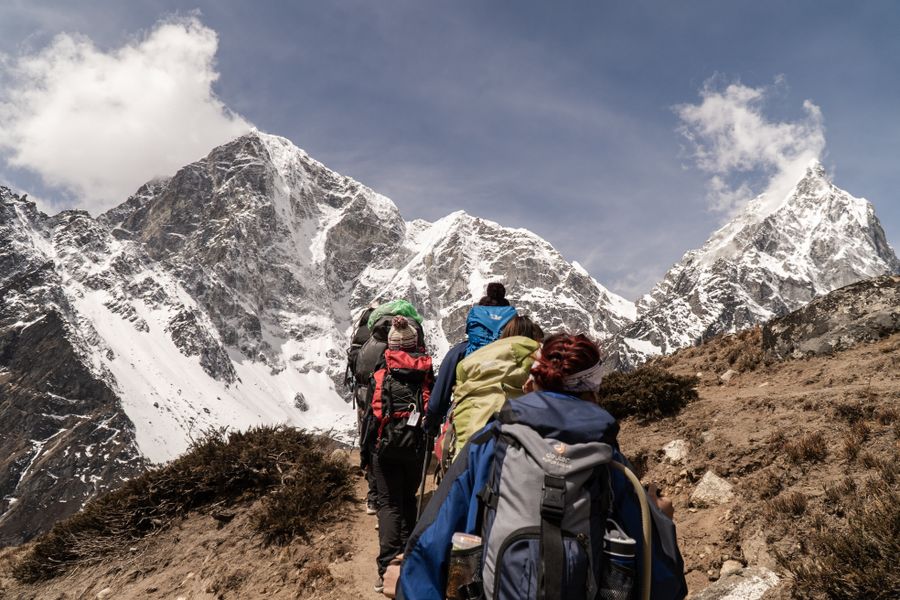
Itinerary at a glance
3 days
| Day |
Route |
Highest point |
Walking |
Overnight |
| 01 |
Pokhara to Ulleri by jeep, walk to Ghorepani |
Ghorepani, 2,860 m |
4 to 5 hours |
Ghorepani |
| 02 |
Ghorepani to Poon Hill and back, then to Tadapani |
Poon Hill, 3,210 m |
7 to 8 hours |
Tadapani |
| 03 |
Tadapani to Ghandruk, jeep to Pokhara |
Tadapani, 2,630 m |
2.5 to 3 hours |
Pokhara |
4 days
| Day |
Route |
Highest point |
Walking |
Overnight |
| 01 |
Pokhara to Nayapul by car, on to Hile, walk to Ulleri |
Ulleri, 2,050 m |
3.5 to 4 hours |
Ulleri |
| 02 |
Ulleri to Ghorepani |
Ghorepani, 2,860 m |
4 to 5 hours |
Ghorepani |
| 03 |
Ghorepani to Poon Hill and back, then to Tadapani |
Poon Hill, 3,210 m |
7 to 8 hours |
Tadapani |
| 04 |
Tadapani to Ghandruk, jeep to Pokhara |
Tadapani, 2,630 m |
2.5 to 3 hours |
Pokhara |
Poon Hill trek difficulty: what makes it hard
The Poon Hill trek is graded moderate, and the reason is stairs, not altitude. Most of the height is gained and lost on stone steps: the staircase from Tikhedhunga up to Ulleri, the long climb through the forest to Ghorepani, the steps to Poon Hill in the dark, and the steep descent from Tadapani to Ghandruk. The total climb from Hile to Poon Hill is about 1,750 m, and you come down more than 1,200 m from Poon Hill to Ghandruk.
The hardest day is the Poon Hill day: an early start, a climb to the top and back before breakfast, then 5 to 6 more hours over Deurali to Tadapani, with a second climb to the pass and many short ups and downs after it. On the 3-day trek, day 1 is also full, because a long jeep ride comes before 4 to 5 hours of uphill walking.
People who walk regularly manage well. Those who find it hardest are people with knee trouble, which the downhill steps make worse, and anyone who has not walked uphill for a long time. Trekking poles help with both. The 4-day version is the better choice if you are unsure of your fitness, because it splits the long climb to Ghorepani over two days.
Altitude and your body
You spend only an hour or so on Poon Hill at 3,210 m, and the highest night is in Ghorepani, at 2,860 m. The US Centers for Disease Control and Prevention (CDC) says in its Yellow Book that altitude illness becomes a risk for travellers who are not used to the height once they sleep at 2,450 m or more, and that symptoms usually start 2 to 12 hours after arrival. So a mild headache or poor sleep in Ghorepani is possible. The serious forms of altitude illness are rare below 4,300 m.
The CDC also advises against going to a sleeping altitude of 2,750 m or more in a single day. The 3-day trek goes from Pokhara, at 820 m, to Ghorepani in one day, a little above that line. The 4-day trek sleeps in Ulleri, at 2,050 m, on the first night and reaches Ghorepani on the second, which is the gentler plan if you are sensitive to altitude. On either trek, drink plenty, keep an even pace, and tell your guide if a headache does not clear with rest and water.
Permits and rules for the Poon Hill trek
The whole trek lies inside the Annapurna Conservation Area, so every trekker needs the Annapurna Conservation Area Permit (ACAP). We get it for you before you start, and your guide carries it. It is checked at Birethanti and at the entrance to Ghorepani. A permit bought at a check post on the trail costs double, so it pays to have it in hand. The fees below have been in place since 2018, when they were set by notice in the Nepal Gazette.
| Who |
ACAP fee |
| Foreign nationals |
NPR 3,000 |
| SAARC nationals |
NPR 1,000 |
| Nepali citizens |
NPR 100 |
| Children under 10 |
Free, no permit needed |
Poon Hill is also on the Nepal Tourism Board's list of trekking routes that need a TIMS card (Trekkers' Information Management System), NPR 2,000 for foreign trekkers and NPR 1,000 for SAARC nationals. It is issued online through a registered agency, and we issue it with your booking. Both are in the price.
Poon Hill: how a grazing ridge became Nepal's best-known viewpoint
Poon Hill was once Lhuntung, a ridge where farmers from the village of Khibang grazed their animals. In the 1970s Major Tek Bahadur Pun of Khibang, a retired Indian Army officer, began calling it Poon Hill, after his own Pun family name, and promoting it to trekkers. A wooden viewing tower went up in 1978 and was replaced with the concrete tower you climb today in 2000.
Ghorepani's tourist police put the number of visitors to the Ghorepani and Poon Hill area at about 30,000 a year. In October and November, and on spring mornings when the rhododendrons are out, a few hundred people stand on the hilltop at sunrise. The local rural municipality charges a ticket at the foot of the steps, NPR 150 for foreign visitors, which your guide pays as part of your permits. At the top there is the tower and a tea stall.
The villages and people of the trail
Ulleri is a Magar village. The Magar are one of Nepal's largest hill peoples, and the Pun clan that gave Poon Hill its name is Magar. The village sits on a ridge so steep that its houses step down the hill one below another, at about 2,050 m.
Ghorepani means "horse water". It grew up as a watering stop on the old trade route between the Kali Gandaki valley and the hills, where salt traders' mule trains and pilgrims bound for Muktinath stopped to rest. Today it is a village of lodges at the top of the climb from Ulleri, in Myagdi district, ward 6 of Annapurna Rural Municipality.
Ghandruk is a Gurung village in Kaski district, with 5,316 residents in the 2021 census. Its stone houses, slate roofs and stone-paved lanes are well kept, and it has a small museum of Gurung life. Many Gurung men from Ghandruk and the villages around it have served in the British and Indian Gurkha regiments. Ghandruk is also where the Annapurna Conservation Area began: it was the site of the first pilot project in 1986.
The rhododendron forest and the conservation area
The National Trust for Nature Conservation, which runs the Annapurna Conservation Area, describes the forest around Ghorepani as one of the largest rhododendron forests in the world. Rhododendron, lali gurans, is Nepal's national flower. Between Banthanti, Ghorepani, Deurali and Tadapani the trail runs through it for most of two days, mixed with oak. The trees flower from mid-March to mid-May, with the peak in late March and April, when the forest turns red, pink and white. A local count cited by Ghorepani's hoteliers puts the number of rhododendron species around Ghorepani at 16.
The conservation area covers 7,629 km² and is home to about 1,226 flowering plants, 523 bird species, 105 mammals, 40 reptiles and 23 amphibians. In the monsoon months the forest floor is wet, and leeches are common.
Teahouse life on the Poon Hill trail
The Poon Hill trail is lined with lodges. Ghorepani has more than 20 hotels with room for over 1,000 people a night. Tadapani is smaller and simpler, a handful of lodges in the forest, where most rooms share toilets.
Lodges serve dal bhat (rice, lentil soup and curry, with free refills), noodles, pasta, potatoes, eggs, porridge and Tibetan bread. Most lodges have wifi, phone charging and solar or gas-heated showers. Rooms are unheated, and Ghorepani is cold at night from November to February, so lodges give you thick blankets and the dining room has a wood stove in the evening. Boiled or filtered water from the lodges saves carrying plastic bottles up the trail.
Poon Hill and Ghorepani altitude: heights on the trek
| Place |
Altitude |
What it is |
| Pokhara (Lakeside) |
820 m |
Where you start and finish |
| Nayapul |
about 1,070 m |
Roadhead on the Baglung highway |
| Hile |
about 1,450 m |
Where the 4-day walk starts |
| Tikhedhunga |
about 1,500 m |
Village at the foot of the Ulleri staircase |
| Ulleri |
2,050 m |
Magar village, 4-day trek's first night |
| Banthanti |
about 2,250 m |
Where the forest begins on the way to Ghorepani |
| Ghorepani |
2,860 m |
Lodge village at the top of the climb |
| Poon Hill |
3,210 m (10,531 ft) |
The sunrise viewpoint, the highest point of the trek |
| Deurali |
3,090 m |
Ridge pass between Ghorepani and Tadapani |
| Tadapani |
2,630 m |
Forest clearing with lodges |
| Ghandruk |
about 2,000 m |
Gurung village, the end of the walk |
Why trek with us
- A local office you can walk into. Visit us at 19 Street Lakeside, Pokhara-6, before you start. Meet your guide, check your gear and pay the balance in person.
- We are a women-led company, owned and run by women. Our founder, Pushpa Sunar, still guides. Our guide team is men and women, and a woman guide can be arranged on request at no extra cost.
- Book direct, in Pokhara. You deal with the people who run your trek, from the first message to the jeep home.
- Two lengths, one loop. You choose 3 or 4 days by your fitness and your time, and either can be extended to Annapurna Base Camp.
Mountains you see from Poon Hill
| Mountain |
Height |
Where on the trek you see it |
First climbed |
| Dhaulagiri I |
8,167 m |
From Poon Hill, the big peak to the west; also from Ghorepani and Deurali |
1960, by a Swiss expedition |
| Tukuche Peak |
6,920 m |
From Poon Hill, right of Dhaulagiri |
1969, by a Swiss team |
| Dhampus Peak |
6,012 m |
From Poon Hill, between Dhaulagiri and Tukuche Peak |
1960, by Kurt Diemberger |
| Nilgiri South |
6,839 m |
From Poon Hill, across the Kali Gandaki |
1978, by a Japanese team from Shinshu University |
| Annapurna I |
8,091 m |
From Poon Hill, a summit behind Annapurna South |
1950, by Maurice Herzog and Louis Lachenal, the first 8,000 m peak ever climbed |
| Annapurna South |
7,219 m |
From Poon Hill, Deurali, Tadapani and Ghandruk |
1964, by a Japanese team from Kyoto University |
| Hiunchuli |
6,441 m |
From Poon Hill, Tadapani and Ghandruk, beside Annapurna South |
1971, by an American team |
| Machhapuchhre (Fishtail) |
6,993 m |
From Poon Hill to the east; closest from Tadapani and Ghandruk |
Never. It is sacred, and climbing is not permitted |
| Gurja Himal |
7,193 m |
From Poon Hill, far to the west of Dhaulagiri |
1969, by a Japanese team |
| Annapurna III |
7,555 m |
From Poon Hill and Tadapani, far to the east |
1961, by an Indian team led by Mohan Singh Kohli |
From Poon Hill the nearest big peaks, Annapurna South and Hiunchuli, are about 20 km away, and Dhaulagiri about 40 km. Between Dhaulagiri and the Annapurnas you look straight into the Kali Gandaki valley, which runs between two 8,000 m peaks. From the river to the summit of Annapurna I is about 5,500 m of height, which makes it one of the deepest gorges in the world.
Mountains you see
| Mountain |
Height |
Where on the trek you see it |
First climbed |
| Dhaulagiri I |
8,167 m |
From Poon Hill, the big peak to the west; also from Ghorepani and Deurali |
1960, by a Swiss expedition |
| Tukuche Peak |
6,920 m |
From Poon Hill, right of Dhaulagiri |
1969, by a Swiss team |
| Dhampus Peak |
6,012 m |
From Poon Hill, between Dhaulagiri and Tukuche Peak |
1960, by Kurt Diemberger |
| Nilgiri South |
6,839 m |
From Poon Hill, across the Kali Gandaki |
1978, by a Japanese team from Shinshu University |
| Annapurna I |
8,091 m |
From Poon Hill, a summit behind Annapurna South |
1950, by Maurice Herzog and Louis Lachenal, the first 8,000 m peak ever climbed |
| Annapurna South |
7,219 m |
From Poon Hill, Deurali, Tadapani and Ghandruk |
1964, by a Japanese team from Kyoto University |
| Hiunchuli |
6,441 m |
From Poon Hill, Tadapani and Ghandruk, beside Annapurna South |
1971, by an American team |
| Machhapuchhre (Fishtail) |
6,993 m |
From Poon Hill to the east; closest from Tadapani and Ghandruk |
Never. It is sacred, and climbing is not permitted |
| Gurja Himal |
7,193 m |
From Poon Hill, far to the west of Dhaulagiri |
1969, by a Japanese team |
| Annapurna III |
7,555 m |
From Poon Hill and Tadapani, far to the east |
1961, by an Indian team led by Mohan Singh Kohli |
From Poon Hill the nearest big peaks, Annapurna South and Hiunchuli, are about 20 km away, and Dhaulagiri about 40 km. Between Dhaulagiri and the Annapurnas you look straight into the Kali Gandaki valley, which runs between two 8,000 m peaks. From the river to the summit of Annapurna I is about 5,500 m of height, which makes it one of the deepest gorges in the world.
Who can do this trek
Anyone in good general health who walks regularly. You don't need trekking experience, and many people do Poon Hill as their first trek in Nepal.
- Fitness: You should be able to walk uphill for 4 to 5 hours with rests, and handle long flights of stone steps downhill.
- Age: We take children from about 8 years old who are used to walking, and older trekkers at a steady pace. For families, the 4-day trek is the better length.
- First-timers: This is a good first trek: the lodges are comfortable, the trail is busy and well marked, and you never sleep high.
- Solo travellers: You walk with your own guide, at your pace.
- Women travellers: We are a women-led company, and a woman guide can be arranged on request at no extra cost.
A simple training plan for the four weeks before you come: walk for an hour three times a week, and once a week take a longer walk of 3 to 4 hours with hills. Use stairs wherever you can: climbing and coming down 20 to 30 flights in a session is the best practice for the Ulleri steps and the descent to Ghandruk.
Which trek suits you?
| |
Poon Hill Trek |
Ghandruk Village Trek |
Mardi Himal Trek |
Annapurna Base Camp and Poon Hill Trek |
| Days |
3 or 4 |
3 |
4, 5 or 7 |
10 |
| Highest point |
Poon Hill, 3,210 m |
Ghandruk, about 2,000 m |
Upper View Point, 4,200 m |
Annapurna Base Camp, 4,130 m |
| Main view |
Sunrise over Dhaulagiri and the Annapurnas |
Annapurna South and Machhapuchhre from a Gurung village |
Machhapuchhre up close from an open ridge |
A full ring of peaks inside the Annapurna Sanctuary |
| Grade |
Moderate |
Easy |
Moderate |
Moderate to hard |
| Price (one trekker) |
USD 295 (3 days) |
USD 215 |
USD 345 (4 days) |
USD 665 |
| Best for |
A short first trek with a big view |
Village life with less climbing |
A quieter ridge and higher altitude |
Poon Hill and the Sanctuary in one trip |