Itinerary at a glance
| Day |
Route |
Highest point |
Walking |
Overnight |
| 1 |
Pokhara to Sikles by jeep, walk to Hugu Goth |
about 2,050 m |
5 to 6 hours |
Hugu Goth |
| 2 |
Hugu Goth to Kapuche Lake and back |
about 2,450 m |
4 to 5 hours |
Hugu Goth |
| 3 |
Hugu Goth to Sikles |
1,980 m |
5 to 6 hours |
Sikles |
| 4 |
Sikles to Pokhara by jeep |
1,980 m |
30 minutes, optional viewpoint |
End of trek |
Kapuche Lake trek difficulty: what makes it hard
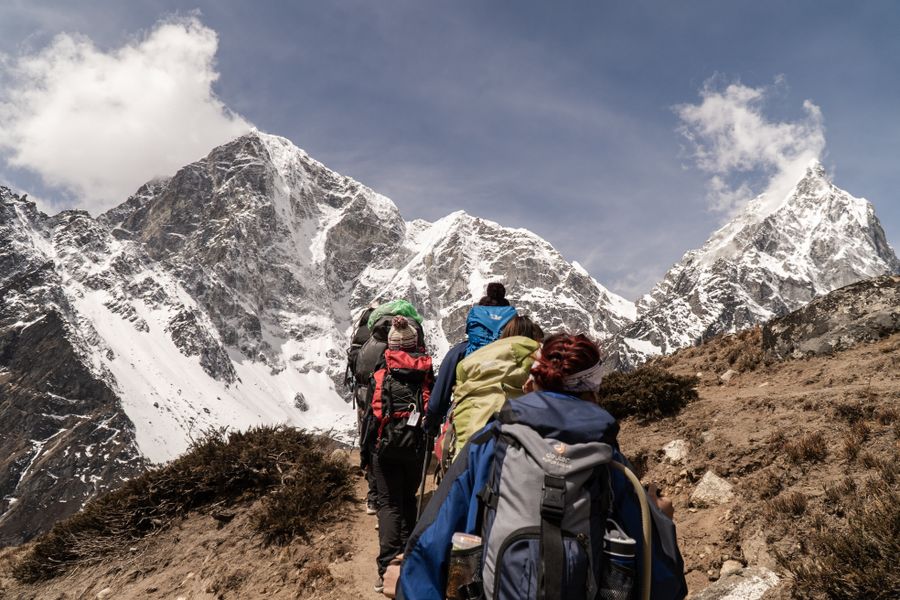
The Kapuche Lake trek is a moderate trek. Altitude is not the issue: the path is. Between Sikles and the lake it is narrow, often steep, and in places little more than a line through the forest, with stone steps, roots, loose rock and short sections above the river. Local guides sometimes clear it with a khukuri knife after the monsoon. Near the lake the path crosses a landslide area that changes from year to year, and your guide decides the safest line on the day.
Day 1 is the longest: a 3 to 4 hour jeep ride on a rough hill road, then 5 to 6 hours on foot. The walk itself has little net height gain, but the path climbs and drops all day as it follows the river, so it tires the legs more than the numbers suggest.
People who struggle are mostly those with weak knees on steep descents, or those not used to uneven ground. If you can walk five or six hours on a hilly forest path, with a few breaks, you can do this trek. You need no technical skills.
Kapuche Glacier Lake: altitude, size and how it formed
| Fact |
Detail |
| Location |
Madi Rural Municipality, Kaski district, at about 28.45° N, 84.12° E, about 2.5 km north of Hugu Goth |
| Altitude |
2,423 m in the 2022 survey by Nepal's Department of Hydrology and Meteorology (DHM). Most maps and signboards say about 2,450 m, and a few say 2,546 m |
| Area |
0.114 km², about 11 hectares, in the same survey |
| Greatest depth |
34 m |
| Age |
Ponds first appeared on buried avalanche ice around 2001, then joined into one lake |
| Fed by |
Avalanches and meltwater from a snowfield at about 7,500 m between Annapurna II and Annapurna IV |
| River |
One of the sources of the Madi river |
The name is Gurung. Kah means ice, phu means tumbling down, and che means flat ground: ice that tumbles down and comes to rest on the flat. That describes the lake's origin well. Over a long time, avalanches from the cliffs above built a fan of ice and debris at the bottom of the bowl. As the climate warmed, the buried ice began to melt, small ponds formed on it, and over the following years they joined into the lake you see now. It is still growing.
A 2023 study in the Journal of Mountain Science, "Evolution and bathymetry of glacial lake at the lowest elevation in Nepal Himalaya", measured the lake and confirmed it as the lowest glacial lake in Nepal. New glacial lakes in Nepal usually form between 4,200 and 5,800 m, on bare moraine above the tree line. Kapuche lies about 2,000 m lower, with forest on its banks. Because it is fed by avalanches rather than held behind the moraine of a retreating glacier, some scientists prefer to call it an avalanche-fed lake.
From the shore you see cliffs, avalanche chutes and ice, not the summits. Kapuche sits so deep in its bowl that Annapurna II and IV are hidden above the walls. The summit views on this trek come from Sikles and the viewpoint above it.
Avalanches at Kapuche
The lake exists because the walls above it shed ice and snow all year. Small avalanches are common, especially in spring and after fresh snow. You usually see the white cloud of powder snow move first, and hear the roar a few seconds later.
In January 2021 a group of young Nepali kayakers was camping beside the lake when a large avalanche broke from the cliffs. Their video shows a white cloud pouring down the face, crossing the lake and rolling over their tents. Nobody was hurt, and the video spread around the world within days. Weeks later it was shared again as footage of the Chamoli disaster in India, and fact-checkers had to confirm it was Kapuche. The group said they had heard several smaller slides in the days before.
That is why we stay on the near shore, where the ground is open and well away from the foot of the walls. Your guide will not take you onto the debris fan on the far side of the lake.
Permits and rules for the Kapuche Lake trek
Kapuche Lake, Hugu Goth and Sikles are all inside the Annapurna Conservation Area, so every foreign trekker needs an entry permit. We arrange it for you before the trek. The fees below are the official rates listed on the National Trust for Nature Conservation (NTNC) e-permit site in 2026, tax included.
| Who |
ACAP entry fee |
| Foreign nationals |
NPR 3,000 |
| SAARC nationals |
NPR 1,000 |
| Children under 10 |
Free, no permit needed |
| Nepali citizens |
No permit needed |
The NTNC charges double for a permit bought at a checkpost on the trail, which is one more reason we arrange it in Pokhara.
Licensed guide rule. Since 1 April 2023, the Nepal Tourism Board has required foreign trekkers in Nepal's national parks and conservation areas to walk with a licensed guide, booked through a registered trekking company. The Annapurna Conservation Area is covered by that rule. Your guide holds a government trekking guide licence.
TIMS card. The Trekkers' Information Management System card is issued through registered companies. In 2026 the checkposts in the Annapurna region mostly ask only for the ACAP permit, but we still issue your TIMS card so your papers are complete.
Sikles and the Gurung people
Sikles sits on a ridge at 1,980 m above the Madi river, facing Annapurna II and Lamjung Himal. It is one of the oldest and largest Gurung settlements in Nepal, and most of its people are Gurung, with some Ghale families. The houses are built close together of stone, with slate roofs, along narrow paved lanes, and the terraced fields fall away below the village to the river.
The Gurung, who call themselves Tamu, have lived in these hills for centuries. Their religion mixes Buddhism with older Bon and shamanic traditions, and many families still call a pachyu or klehpree priest for funerals and household rites. Tamu Lhosar, the Gurung new year, falls at the end of December, with dancing and family feasts. Many Sikles families have sons who served in the British and Indian Gurkha regiments.
Sikles is also the home village of Dr Chandra Prasad Gurung, one of Nepal's most important conservationists. He was the first director of the Annapurna Conservation Area Project, from its start in 1986 until 1994, and built its model of local people managing the forests around them. He brought a 100 kW hydropower plant to Sikles in 1993. He died in 2006, with 23 others, in a helicopter crash in Taplejung that killed many of Nepal's leading conservationists. The Annapurna Conservation Area Project still has an office in Sikles.
The government lists Sikles among Nepal's 100 important tourist destinations, and by 2018 the village had 12 hotels and 15 homestays, mostly used by Nepali visitors who come up by jeep for a night or two.
The Madi valley forest
The Annapurna Conservation Area covers 7,629 km². It began as a pilot project in Ghandruk in 1986, was gazetted in 1992, and is run by the National Trust for Nature Conservation, funded by the entry fees trekkers pay. Its model lets local communities manage the forests, and the upper Madi valley shows the result: a near-continuous forest from Sikles to the lake.
Lower down, the forest is oak and rhododendron, the national flower of Nepal, which flowers red and pink in March and April. Higher up, bamboo thickets and fir take over. The same forests continue east towards Kori, where camera traps have recorded common leopard, Himalayan black bear and smaller cats. You are unlikely to see them, but your guide may point out bear signs on the trail. In the monsoon the forest floor is wet and full of leeches.
Lodges at Hugu Goth and Sikles
Hugu Goth is a goth, a herders' clearing with shelters for animals and people. Until a few years ago trekkers slept in tents or in an empty herders' hut. Today there are two or three small, basic lodges. Expect simple shared rooms with thin mattresses, a kitchen where everyone gathers in the evening, a cold-water tap or the river for washing, and a basic toilet outside. Electricity comes from small solar panels, so charging is limited and may cost extra. There is little or no mobile signal and no wifi.
The menu is short: dal bhat (rice, lentils and vegetable curry, with free refills), noodles, potatoes, eggs and tea. In the main seasons there are also small seasonal tea stalls near the lake. In winter and the monsoon, some lodges at Hugu Goth may close, and we confirm which one is open before you set out.
Sikles is different: a real village with several guesthouses and family homestays, attached rooms and hot showers in some, and mobile signal. Bring Nepali rupees in cash: there is no ATM in Sikles, and nothing on the trail takes cards.
Elevation table
| Place |
Altitude |
What it is |
| Pokhara (Lakeside) |
820 m |
Start and end |
| Sikles |
1,980 m |
Gurung village, road-head, night 3 |
| Hugu Goth |
about 2,050 m |
Herders' clearing with small lodges, nights 1 and 2 |
| Kapuche Lake |
about 2,450 m |
Glacial lake, the high point of the trek |
| Snowfield between Annapurna II and IV |
about 7,500 m |
Source of the avalanches that feed the lake |
| Annapurna II |
7,937 m |
The peak above the lake |
Why trek with us
- We are a women-led company, owned and run by women. Our founder, Pushpa Sunar, still guides. Our guide team is men and women, and we can arrange a woman guide at no extra cost.
- Our office is in Lakeside. Come to 19 Street, Lakeside, Pokhara-6, before your trek to meet your guide and ask your questions.
- Prices are on the page. You see what you pay for your group size before you contact us.
- We start and finish in Pokhara. The trek, the jeep and the permits are all handled from our own town.
- Licensed and registered. Company Reg. No. 296955/079/080, Tourism Licence No. 236.
Mountains you see
| Mountain |
Height |
Where on the trek you see it |
First climbed |
| Annapurna II |
7,937 m |
From Sikles and the viewpoint above it. At the lake, its lower walls rise above you |
17 May 1960, by Richard Grant, Chris Bonington and Ang Nyima Sherpa, on an expedition led by Jimmy Roberts |
| Annapurna IV |
7,525 m |
From Sikles on clear mornings, beside Annapurna II. The snowfield between the two feeds the lake |
1955, by a German expedition |
| Lamjung Himal |
6,983 m |
From Sikles and the viewpoint above it, to the north-east |
1974, by Derrick Chamberlain and Phillip Neame |
Who can do this trek
Fitness. You need to walk five or six hours a day on a steep, uneven path. Regular walkers manage it well. No previous trek is needed.
Age. Children from about 10 years old who are used to walking do well, and children under 10 need no permit. Fit trekkers in their sixties and seventies do this trek, as long as their knees are good on descents.
First-timers. This is a good first trek in Nepal if you want something quieter than the Poon Hill trail. The low altitude takes away the biggest worry of trekking in the Himalaya.
Solo travellers and women. You walk with your own guide, whatever your group size. We can arrange a woman guide on request. Sikles and Hugu Goth are small, friendly places where lodge owners look after their guests.
Getting ready. In the four weeks before, walk for two or three hours with a light pack, on hills or stairs, at least twice a week. Include long downhill sections, because the descent from the lake and the walk back to Sikles are what tire most people.
Which trek suits you?
| Option |
Days |
What it is |
Highest point |
Price for one |
| Kapuche Lake Trek |
4 |
Sikles, the Madi valley forest and the glacial lake |
about 2,450 m |
USD 385 |
| Kori Danda Trek |
6 |
Sikles, Hugu Goth and the open ridge of Kori Danda |
about 3,800 m |
USD 475 |
| Sikles Village Trek |
3 |
Gurung village life in Sikles and Tangting, no high trail |
about 1,980 m |
USD 275 |
| Kapuche Lake Helicopter Tour |
Morning |
Fly from Pokhara and land beside the lake |
about 2,450 m |
USD 400 a seat |
Choose the Kapuche Lake trek for the lake and the forest in four days. Choose Kori if you have six days and want big mountain views from a high ridge. Choose the Sikles village trek for Gurung culture without the rough trail.